
ONE PARTNER, ENDLESS POSSIBILITIES

How a $5K monthly ad spend should be allocated in 2026

$5,000 a month is an interesting budget to work with. It’s enough to actually learn something from your ad spend, but not so much that you can afford to spread it thin across every channel “just to see.” The founders who get the most out of a budget this size tend to concentrate it rather than scatter it. Here’s a framework that holds up well heading into 2026.

Key takeaways

  • Figure out where your best customers actually convert before splitting the budget.
  • A workable starting split: ~40% high-intent search, ~35% social, ~25% testing.
  • Set aside 10–15% for retargeting — usually the cheapest clicks in the budget.
  • Give each channel three to four weeks before judging it.
  • Revisit the allocation monthly as real cost-per-lead data comes in.

Start by figuring out where your customers already are

Before splitting a dollar amount across channels, get honest about where your best customers actually convert. A B2B service business and a consumer product brand have almost nothing in common here — one probably belongs on search and LinkedIn, the other on social and marketplace ads. If you don’t have a clear answer yet, that’s fine; it just means the first month of a $5K budget should go toward finding out, not scaling.
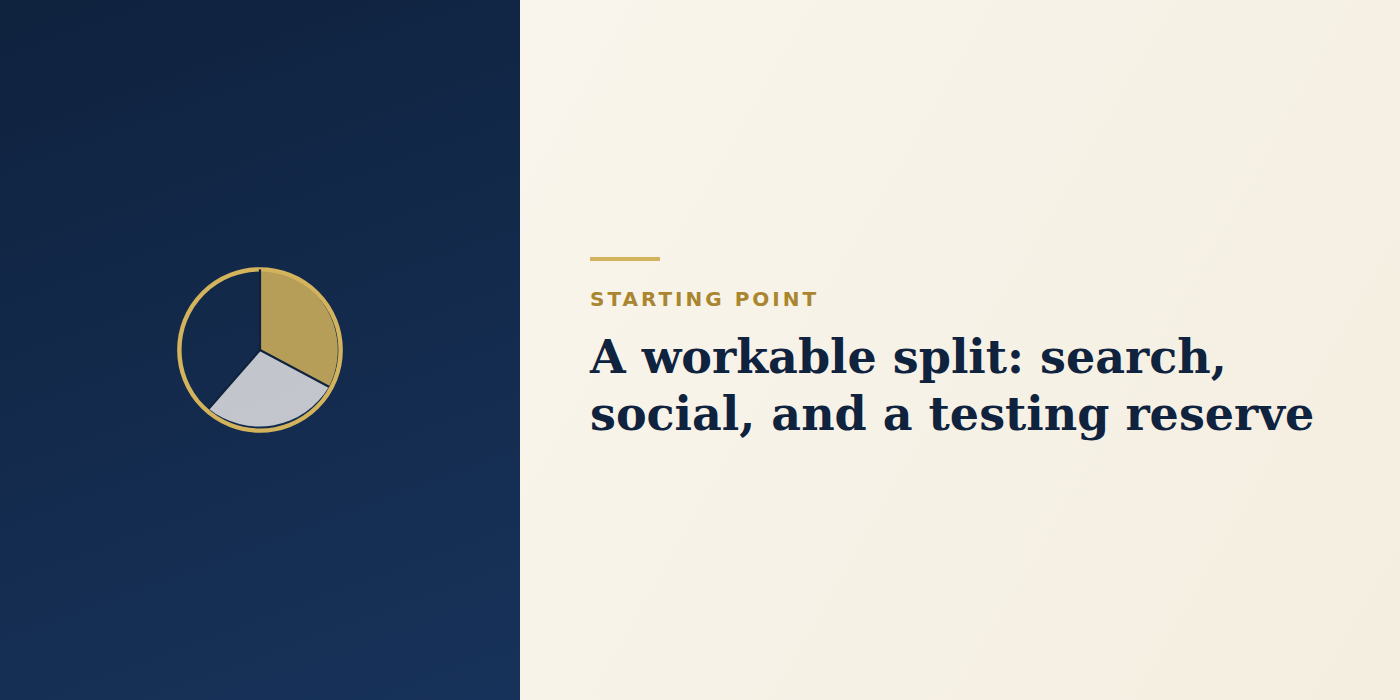
A workable ad budget split: search, social, and a testing reserve

A workable starting split

For a business without strong existing data, a reasonable starting allocation looks something like this: roughly 40% toward the channel with the clearest buying intent (usually search or Google Ads for anything people actively look for), 35% toward social advertising for awareness and retargeting, and the remaining 25% held back for testing — new audiences, new creative, or a channel you suspect could work but haven’t proven yet. That testing slice matters more than it sounds like it should; it’s how you find your next scalable channel before you’re forced to.

A $5K budget spread across six channels teaches you nothing. The same budget concentrated on two teaches you everything.

Don’t skip retargeting

At this budget size, it’s tempting to put everything toward cold traffic. Resist that. Setting aside even 10-15% of the total for retargeting warm visitors — people who’ve already been to your site or engaged with a post — usually produces your cheapest, highest-converting clicks in the whole budget. It’s the easiest win most small budgets leave on the table.

Give each channel enough time to actually tell you something

A common mistake is judging a channel after five days and four hundred dollars of spend. Most ad platforms need a couple of weeks and a meaningful sample size before the data means anything. Set a floor — say, three to four weeks — before you make a call to cut or scale a channel, unless the early numbers are dramatically one-sided.

Revisit the ad spend allocation monthly, not once a year

Layer in organic where it’s cheap to do

Paid budget goes further when it’s not doing all the work alone. If organic search or steady content is already bringing in some traffic, your ad budget can focus on the gaps rather than competing with your own organic rankings for the same keywords.

Revisit the split monthly, not yearly

A $5K budget shouldn’t be allocated once in January and left alone. As you get real numbers on cost per lead or cost per sale by channel, shift the split toward what’s actually converting. By month three or four, your allocation should look noticeably different from your first guess — and that’s exactly the sign it’s working.

The businesses that make a modest ad budget go furthest are usually the ones tracking it closely and adjusting monthly, not the ones with the fanciest media plan. If you’d rather have that tracked and managed for you, lead generation and ad management is exactly what we handle for founders working with budgets this size.

Want your ad budget actually managed, not just spent?

We handle lead generation and ad management for founders running budgets this size.

See marketing services

The Q4 e-commerce checklist for Amazon sellers

If you sell on Amazon, Q4 is the whole game. Depending on your category, it’s not unusual for 30-40% of annual revenue to land between October and December. Which means the sellers who go into the quarter with a plan tend to have a very different holiday season than the ones scrambling through it. Here’s what actually matters.

Key takeaways

  • Place restock orders early — FBA limits and inbound restrictions tighten as Q4 goes on.
  • Audit your top listings in early November, while there’s still time for fixes to pay off.
  • Clear account health flags before Amazon’s peak-season enforcement ramps up.
  • Budget for a Q1 return wave now, so it doesn’t surprise your cash flow later.
  • Check campaign performance weekly — CPCs climb fast as competition heats up.

Get your inventory numbers right, early

Nothing kills a strong Q4 faster than going out of stock on your best sellers in the second week of December. Pull your sales velocity from last Q4 (or, if this is your first big season, your best comparable month) and work backward from there. Amazon’s FBA storage limits and inbound restrictions tighten up as the season goes, so the further out you place restock orders, the more flexibility you keep. If your inventory management has been more reactive than planned up to now, this is the month to fix that.

Inventory decisions made in October pay off in December

Audit your listings before the traffic shows up

Go through your top ASINs with fresh eyes. Are the main images still sharp on mobile? Does your bullet copy answer the questions shoppers actually have, or just list specs? Small listing fixes made in early November pay off across the entire holiday traffic spike — the same fix made in late December barely has time to matter.

The sellers who win Q4 aren’t the ones with the biggest catalog — they’re the ones whose best sellers never go dark.

Check your seller account health

Amazon tends to enforce policies more strictly heading into peak season, since they’re protecting the buyer experience for their biggest quarter too. Take a pass through your account health dashboard, clear up any late shipment or order defect flags, and make sure your seller account settings — return policies, shipping templates, holiday deadlines — are actually current and not left over from last year.

Plan for returns now, not in January

Q4 sales come with a Q1 return wave attached. Build that into your cash flow expectations so a string of January refunds doesn’t feel like a surprise. It’s also worth reviewing your return reasons from last year — if the same issue keeps showing up, that’s usually a sizing, description, or packaging fix worth making before the next peak season starts.

Revenue and cash position rarely move together in Q4

Watch cash flow, not just revenue

Amazon’s disbursement schedule and reserve holds mean the cash from a big December doesn’t always land in your account when you’d expect. Revenue can look great on paper while your actual cash position lags behind it by weeks. Keeping a close eye on your sales and revenue reporting through the quarter, rather than waiting to reconcile it all in January, makes it much easier to plan reorders and ad spend without guessing.

Don’t set your ad budget and walk away

Cost per click climbs through Q4 as every seller in your category bids harder for the same eyeballs. Budgets that made sense in September can quietly underperform by December if nobody’s adjusting them. Check in on campaign performance weekly through the season rather than letting it run on autopilot.

Q4 rewards sellers who did their planning in October, not the ones improvising in December. If any piece of this — inventory, reporting, account setup — feels like more than you can keep on top of alongside everything else, that’s the kind of groundwork our team handles for e-commerce sellers heading into peak season.

Heading into peak season without a plan?

We help Amazon and e-commerce sellers with inventory management, reporting, and seller account setup year-round.

See e-commerce services

Year-end tax moves every founder should consider

Q4 has a way of sneaking up on founders. One minute you’re pushing through summer sales, and the next you’re staring down December with a stack of loose receipts and a vague sense that you should “get your books in order.” If that sounds familiar, you’re not alone — and the good news is that most of what actually matters this time of year isn’t complicated. It just needs to happen before January.

Key takeaways

  • Reconcile your books before your tax preparer ever opens your file — not after.
  • Separate personal and business spending now, while records are still fresh.
  • Pull your contractor payment list early so 1099s aren’t a January scramble.
  • Pair your year-end close with a real look at your financial statements.
  • Sketch next year’s budget while this year’s numbers are still top of mind.

Start with your books, not your return

The biggest mistake we see founders make is treating tax season as a January problem. By the time your tax preparer opens your file, the real work — reconciling every account, matching transactions to receipts, sorting out what’s actually a business expense — should already be done. Trying to squeeze a year’s worth of bookkeeping into three weeks is how deductions get missed and founders end up paying more than they needed to, not because the rules changed, but because nobody had time to look closely.

If your books have been slipping for a few months, now’s the moment to close the gap. A proper bookkeeping and reconciliation pass before year-end gives your tax preparer clean numbers to work with, and gives you an honest read on how the year actually went.

Step one: clean books before you touch the return

Separate the personal from the business, for real this time

Every founder means to keep personal and business spending separate. Fewer actually manage it consistently. If your business card has covered the occasional personal purchase (or vice versa), December is the time to go back and flag it — not April. This one habit alone makes filing faster and makes your financial statements far more trustworthy if you ever need to show them to a lender or investor.

The founders who go into January calm are almost never the ones with the fewest problems — they’re the ones who closed the gaps in November.

Review contractor payments before the 1099 deadline creeps up

If you paid any freelancers or contractors $600 or more this year, you’ll need to issue 1099s in January. Pull that list now, while you still have time to track down a missing W-9 or a current mailing address, instead of scrambling the first week of the new year.

Look at your numbers as a whole, not just at tax time

A year-end close is also a good excuse to actually sit with your financial statements — not just the P&L, but your cash position and where the money went by category. It’s easy to run a business quarter to quarter and never step back far enough to see the pattern. If you haven’t had a proper financial statement review done recently, pairing it with your year-end close means you walk into January already knowing where you stand.

Close this year, then budget the next

Set next year’s budget while this year is still fresh

It’s tempting to close out December and immediately move on to whatever’s next. But you have more context on your business right now than you will in March. Use it. Block out an hour to sketch a rough budget for next year based on what actually happened this year, not what you hoped would happen. Founders who do this tend to make faster, less reactive decisions the following year.

A quick note on all of this

None of the above replaces a conversation with your tax preparer, who knows your specific filing situation better than any blog post can. What we’re talking about here is the groundwork — clean books, sorted records, a clear picture of the year — that makes that conversation shorter and a lot less stressful. If getting there feels like more than you have bandwidth for right now, that’s exactly the kind of back office support we handle for founders every year around this time.

Want your books ready before year-end?

Our back office team handles reconciliation, financial statements, and budget planning for founders year-round.

Talk to our team